


Do Crow Bird Scarers work on crows of all ages?
As a supplier of crow bird scarers, I've often been asked whether our products are effective against crows of all ages. It's a valid question, considering that different age groups of crows may have distinct behaviors, learning abilities, and levels of wariness. In this blog post, I'll delve into the science behind crow behavior, explore how age can influence their response to bird scarers, and share insights on the effectiveness of our products across different age demographics of crows.
Understanding Crow Behavior
Crows are highly intelligent and social birds. They belong to the Corvidae family, which also includes ravens, magpies, and jays. These birds are known for their problem - solving skills, long - term memory, and ability to communicate with each other. Crows live in family groups and have a complex social structure.
Young crows, or fledglings, are dependent on their parents for food and protection. They are still learning about the world around them, including what to eat, where to find shelter, and which threats to avoid. As they grow, they start to explore their environment more independently but still rely on the guidance of older crows.
Adult crows, on the other hand, have a wealth of experience. They have learned from past encounters and are more likely to be cautious around new objects or situations. They can recognize potential threats and communicate this information to other members of their group.
How Age Affects Response to Bird Scarers
Fledglings
Fledgling crows are generally more naive and less experienced than adult crows. They may be more easily startled by new and unfamiliar objects. Our crow bird scarers, which often use visual and auditory stimuli to deter crows, can be quite effective on fledglings. For example, a Plastic Heron Garden Ornament can mimic a predator and scare young crows away. Since fledglings are still learning what is dangerous, the presence of a plastic heron can be perceived as a real threat.
However, fledglings are also more likely to habituate to the scarers over time. If they see the same object in the same place repeatedly without any real danger, they may start to lose their fear. This is why it's important to move the scarers around regularly or use a combination of different types of scarers.
Juvenile Crows
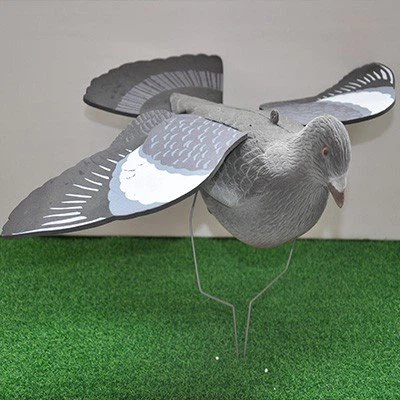
Juvenile crows are in a stage of transition between fledglings and adults. They have more experience than fledglings but are still not as cautious as adult crows. They are more likely to test the boundaries and investigate new objects. Our Simulation Pigeon scarers can be effective on juvenile crows. The simulation of a pigeon, which is a common sight in many areas, can attract the curiosity of juvenile crows. But when the pigeon suddenly moves or makes a noise, it can startle them and keep them away.
However, like fledglings, juvenile crows can also learn quickly. If they figure out that the scarer is not a real threat, they may become less affected by it.
Adult Crows
Adult crows are the most challenging to deter. They have a high level of intelligence and are very cautious. They can recognize patterns and remember past experiences. For example, if they have encountered a particular type of bird scarer before and realized it was harmless, they are likely to ignore it in the future.
To be effective against adult crows, our bird scarers need to be more sophisticated. We offer a range of products that use advanced technology, such as motion - activated lights and sounds. These scarers can change their behavior randomly, making it difficult for adult crows to predict and adapt. Our Plastic Garden Ducks can also be part of a multi - pronged approach. When combined with other scarers, they can create a more complex and unpredictable environment that adult crows find intimidating.
Effectiveness of Our Crow Bird Scarers
Our company has conducted extensive research and testing to ensure that our crow bird scarers are effective against crows of all ages. We understand that no single scarer can work all the time, especially against adult crows. That's why we offer a variety of products that can be used in combination.
For example, we recommend using visual scarers like the plastic heron and simulation pigeon during the day and auditory scarers at night. This way, we can keep crows on their toes and prevent them from getting used to any one type of deterrent.
We also provide our customers with guidelines on how to use the scarers effectively. Moving the scarers around regularly, changing the settings of the auditory scarers, and using different combinations of products can all increase the effectiveness of our bird scarers.
Conclusion
In conclusion, while our crow bird scarers can be effective against crows of all ages, the level of effectiveness may vary. Fledglings and juvenile crows are generally more easily deterred but may habituate quickly. Adult crows, with their high intelligence and experience, require more sophisticated and dynamic scarers.

If you're dealing with a crow problem on your property, whether it's a small garden or a large agricultural area, our range of crow bird scarers can provide a solution. We are committed to providing high - quality products and excellent customer service. If you're interested in learning more about our products or would like to discuss your specific needs, please feel free to reach out to us. We're here to help you find the best way to keep crows away and protect your property.
References
- Bernd Heinrich, "Mind of the Raven: Investigations and Adventures with Wolf - Birds".
- John M. Marzluff and Tony Angell, "In the Company of Crows and Ravens".
- Various scientific studies on avian behavior and bird deterrence published in ornithological journals.


